
Barcelona's Masterclass Under the Tyneside Stars
Barca sizzle in a fantastic away win at Newcastle while back home Bordalas comes calling as the wage bill slips by another €112M

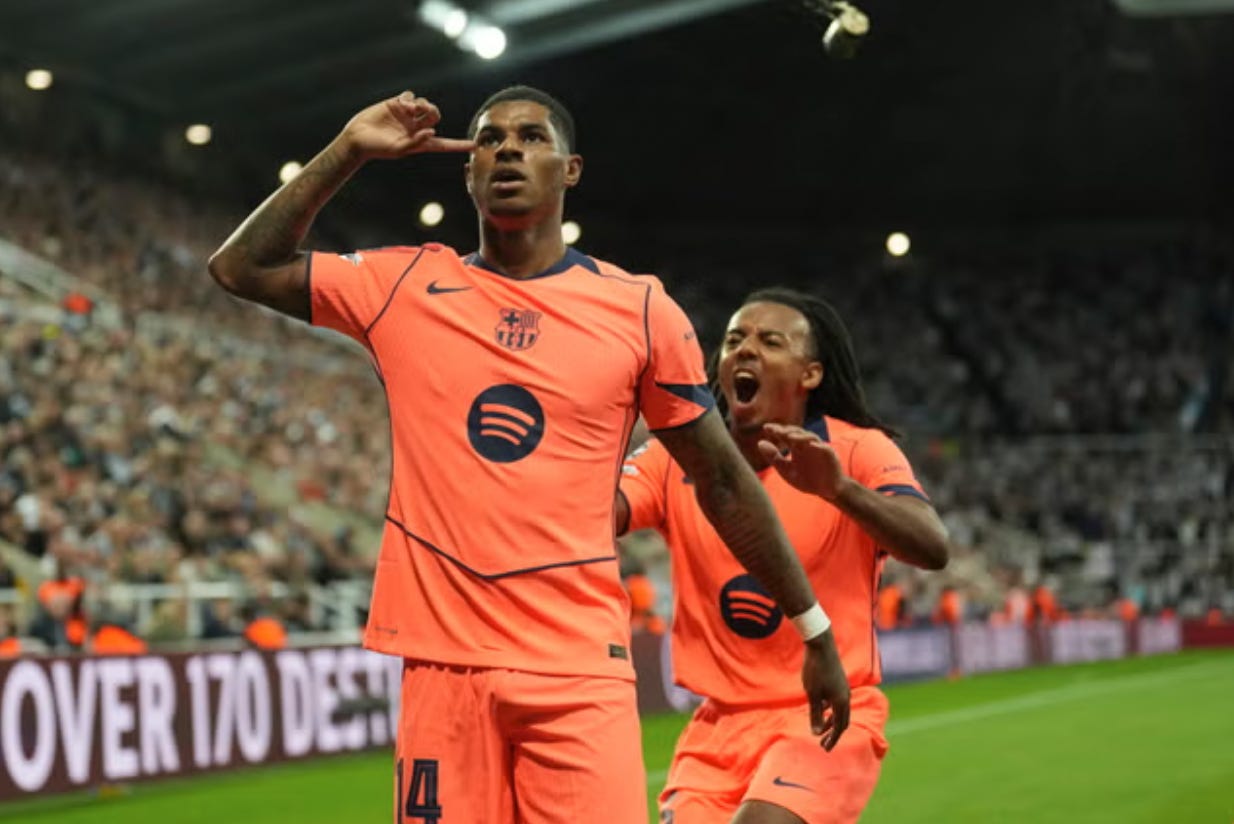
The Champions League anthem echoed around St. James' Park like a battle cry. Black and white scarves swirled above 52,000 Geordies who had waited for this moment—their beloved Newcastle back among Europe's elite. The atmosphere was, in the words of one witness, "simply electrifying." Giant flags unfurled across the Gallowgate End, and for twenty minutes, Barcelona felt the full fury of Tyneside passion.
Yet by the final whistle, it was the Catalans who were smiling, having delivered a clinical display that left even the most partisan Newcastle supporter grudgingly applauding. This wasn't just a 2-1 victory; it was a demonstration of why "broke" Barca still remain a European highlight, even in the hostile cauldron that is St. James' Park on a Champions League night.
Newcastle's Early Storm
The opening exchanges crackled with the intensity that has made St. James' Park legendary. Newcastle, energised by an atmosphere described as "unbeatable" and "second to none," pressed Barcelona high up the pitch with the ferocity of a team that belonged on this stage. For twenty minutes, it felt like 1997 all over again—when Faustino Asprilla inspired a magical 3-2 victory over these same opponents.
The statistics, however, tell a different story than the emotional narrative unfolding in the stands. While Newcastle's early pressure created moments of excitement, Barcelona were quietly establishing the foundation for their dominance.
Harvey Barnes nearly gave Newcastle their dream start, latching onto Anthony Elanga's cross at the far post, only to be denied by Joan García's reflexes. But Barcelona's 64% possession and 84% pass accuracy revealed the true pattern of play—the Catalans were weathering the storm while slowly asserting their technical superiority.
Flick's Pragmatism
Perhaps the most significant development in this Barcelona performance was Hansi Flick's tactical maturation. Gone was the high line that had occasionally left Barcelona exposed last season. Instead, Flick deployed a more measured defensive approach, with Barcelona's average formation line lower than Newcastle's, representing a notable retreat from the extreme pressing that defined last season.
With Inigo gone, this wasn't cowardice—it was practicality. Barcelona maintained their pressing intensity where it mattered, but they did so from a more secure base. The result was a team that could press aggressively in Newcastle's half while maintaining defensive stability when required.
The wisdom of this approach became apparent as the match wore on. Newcastle's pace on the counter, particularly through Gordon and Barnes, found fewer gaps to exploit. Barcelona had learned to be patient predators rather than reckless hunters.
Death by a Thousand Passes
As the first half progressed, Barcelona's possession-based approach began to smother Newcastle's early enthusiasm. The visitors completed 541 passes at 84% accuracy, a staggering contrast to Newcastle's 290 passes at 72% accuracy. These weren't merely sideways passes—Barcelona recorded 44 progressive passes compared to Newcastle's 33, constantly probing for weaknesses in the Magpies' defensive structure.
The pressing statistics reveal the suffocating nature of Barcelona's approach. Newcastle could barely string seven passes together before losing possession, while Barcelona's structured pressing forced the hosts into increasingly desperate decisions.
The Tale of Two Networks
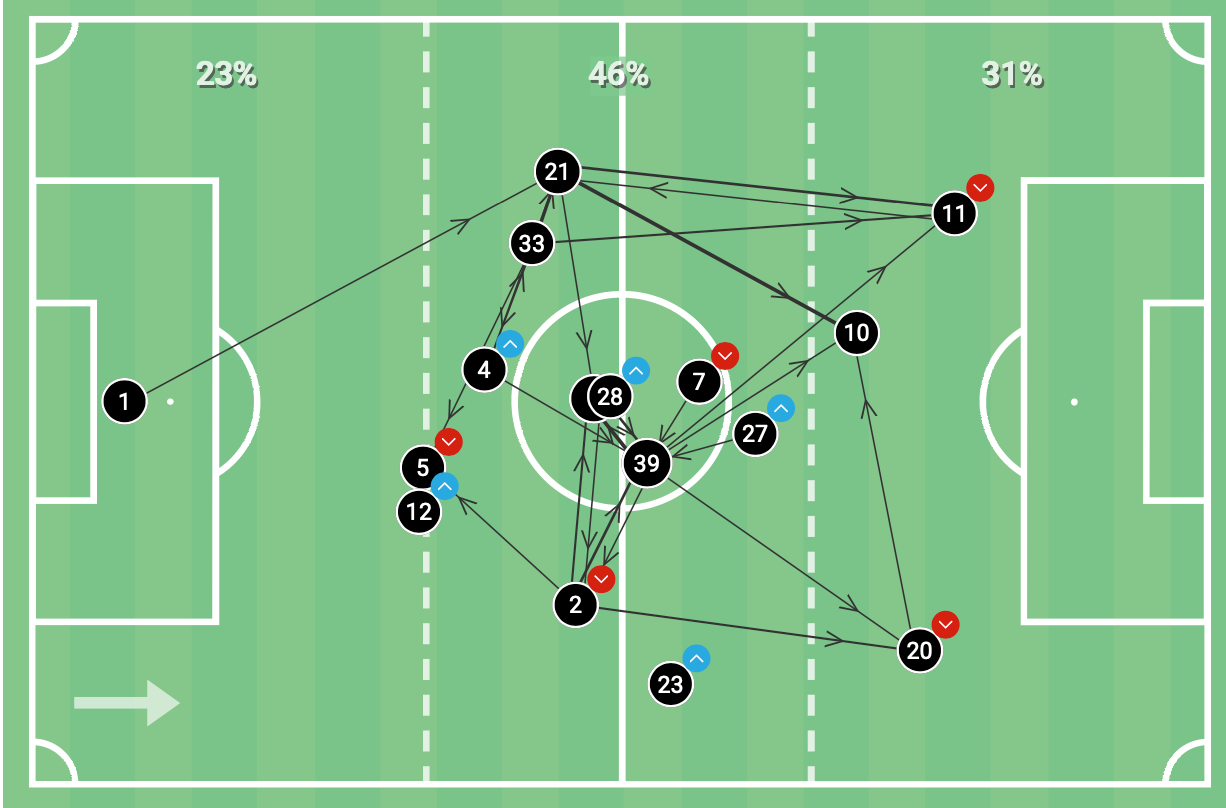
The visual evidence of Barcelona's technical superiority becomes starkest when examining the pass maps. (Barca Red: Newcastle Black). Newcastle's passing network reveals a functional but limited approach—a relatively sparse web of connections concentrated around key players like Bruno Guimarães (39), Joel Linton (7), and Livramento (21). Their territorial distribution shows 23% in the defensive third, 46% in the middle third, and 31% in the attacking third—a reasonable balance but one that suggests limited variety in their build-up patterns.
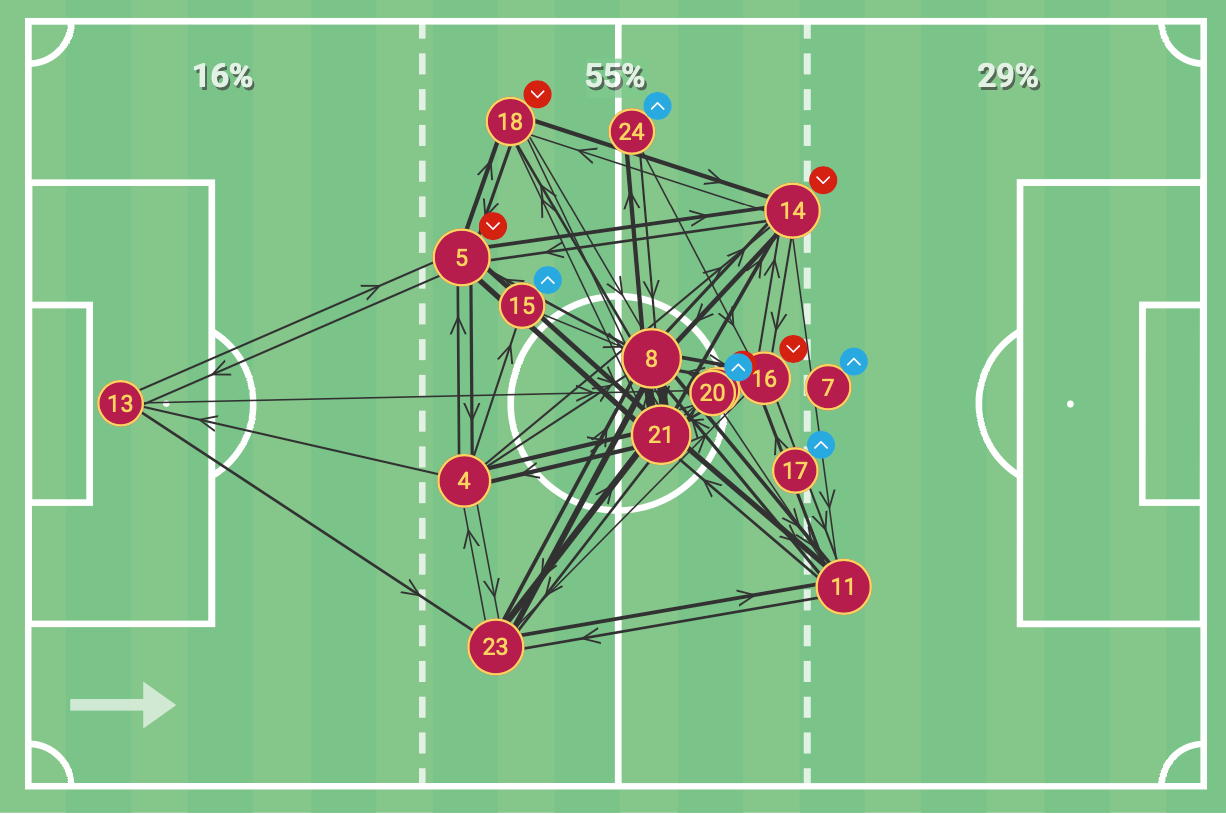
Barcelona's pass map tells an entirely different story. The Catalan network resembles a web of interconnected passing lanes, with virtually every outfield player connected to multiple teammates. The density of passing combinations between Pedri (8), De Jong (21), and the defensive trio of Koundé (23), Araújo (4), and Pau Cubarsí (5) creates a foundation for sustained possession that Newcastle simply couldn't disrupt.
Most revealing is Barcelona's territorial control: 16% defensive third, 55% middle third, 29% attacking third. This concentration in the middle third reflects their ability to dominate the crucial transition zones, constantly recycling possession while probing for openings. The sheer complexity of their passing network—with multiple thick connection lines between players—demonstrates why Newcastle's pressing struggled to find consistent triggers.
Where Newcastle's map shows isolated pockets of passing combinations, Barcelona's reveals a team capable of switching the point of attack through multiple channels, making their possession not just statistically dominant but tactically devastating.
The Pedri-De Jong Axis: Barcelona's Beating Heart
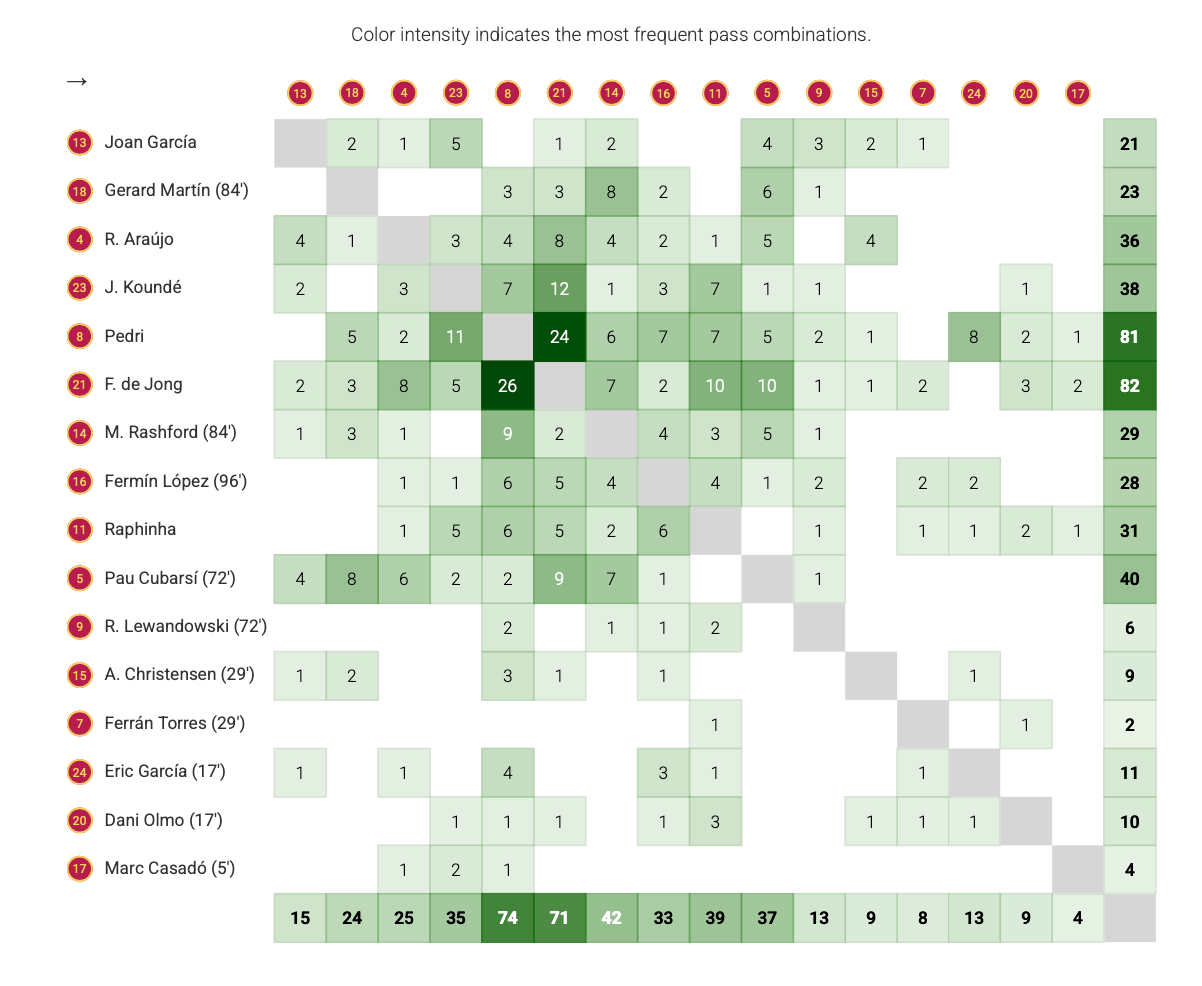
The passing combination matrix reveals the tactical foundation of Barcelona's dominance: the Pedri-De Jong partnership that exchanged 50 passes between them (26 from De Jong to Pedri, 24 in return). This represented the most frequent passing combination on the pitch, forming an unbreakable central axis that Newcastle never successfully disrupted.
Pedri, with 81 total passes received, became Barcelona's primary distribution hub. His strongest partnerships extended beyond De Jong to include 12 combinations with Koundé and 9 with Rashford, demonstrating his ability to link defense with attack seamlessly. The Spaniard's positioning allowed him to receive passes from the defensive line, combine with De Jong, then find Barcelona's attacking threats in the final third.
De Jong, recording 82 total pass combinations, functioned as the deeper orchestrator. His 26 passes to Pedri anchored Barcelona's build-up, but his distribution spread across the pitch: 10 combinations each with Raphinha and Pau Cubarsí, 8 with Araújo, and 7 with Rashford. This variety in passing targets made him virtually impossible to mark out of the game.
Ronald Araújo: The Defensive Anchor
Araújo's 36 total passing combinations reflected his role as a progressive center-back. His strongest partnership with De Jong (8 combinations) provided Barcelona with a reliable outlet when building from deep positions, while his 5 combinations with Pau Cubarsí and 4 with Koundé showed the fluidity across Barcelona's defensive line.
The Uruguyan's 15 duels with 6 won (40% success rate) might seem modest, but his 7 aerial duels yielding 3 wins (43%) were crucial in dealing with Newcastle's direct approach. His 11 recoveries, 4 in Newcastle's half, illustrated his willingness to step up and disrupt play before it reached dangerous areas.
Jules Koundé: The Attacking Full-Back
Koundé's 38 total passing combinations revealed his dual role as defender and attacking catalyst. His 12 combinations with De Jong and 7 each with Pedri and Raphinha demonstrated his ability to link play between the defensive and attacking thirds. This positional intelligence allowed him to provide the cross for Rashford's opening goal, showcasing how Barcelona's system creates scoring opportunities from seemingly defensive positions.
Joan García: Distribution Under Pressure
The Barcelona goalkeeper's passing statistics reveal a calculated approach to distribution that perfectly suited Barcelona's possession philosophy. García's 21 total passing combinations were strategically distributed, with 5 passes to Koundé and 4 to Pau Cubarsí forming the foundation of Barcelona's build-up play.
When playing longer, García primarily targeted his forwards and wide players, with 4 successful passes to Lewandowski and 2 to Rashford among his passes beyond the halfway line. This direct approach allowed Barcelona to quickly transition from defensive actions to attacking positions, bypassing Newcastle's midfield press.
More tellingly, García's short distribution demonstrated Barcelona's commitment to playing out from the back even under intense pressure. His variety in short passing options prevented Newcastle from successfully pressing any single defender consistently.
His 5 saves, including 2 crucial reflex stops, demonstrated his shot-stopping credentials when called upon. Most importantly, he never panicked under pressure, constantly providing a secure option for his defenders to recycle possession.
The Rashford Show: Clinical When It Mattered
Marcus Rashford's double provided the moments of individual brilliance that separated the sides. His 58th-minute header, converted from Jules Koundé's precise cross, showcased his movement and timing. But it was his 67th-minute thunderbolt from 25 yards, crashing off the crossbar before nestling in the net, that left even the partisan St. James' crowd momentarily silenced.
The Manchester United loanee's 29 total passing combinations included crucial links with the midfield creators: 9 with Pedri and 7 with De Jong. These connections allowed him to drop deep to collect possession before making his runs into scoring positions, illustrating the intelligence that made his goals possible.
The Final Seven Minutes: A Masterclass in Game Management
Anthony Gordon's 90th-minute goal from Jacob Murphy's cross briefly threatened to spoil Barcelona's party, but what followed was a clinic in possession-based game management.
Much had been said post Barca's defeat to Inter in the semi-finals last season but on the surface of it, the catalans seemed to to have learnt from that heartbreak. In those final seven minutes of regulation time plus stoppage time, Barcelona barely allowed Newcastle to touch the ball.
The Pedri-De Jong axis that had dominated the match with their 50 pass combinations became the architects of this suffocation. Their understanding, built through countless training sessions and matches, allowed them to find each other under pressure while drawing Newcastle players out of position. The duo's quick passing and intelligent movement, supported by the network of combinations they had built with their teammates throughout the match, methodically ran down the clock.
This wasn't mere time-wasting—it was sophisticated football intelligence. Barcelona maintained their passing accuracy and tempo while turning possession into a weapon of game management, demonstrated perfectly by the passing combination matrix that showed their superiority in every area of the pitch.
Even in defeat, Newcastle earned widespread respect. One Geordie supporter captured the mood: "It was great to be there, a special atmosphere on a special night and I know we lost, but other than PSG away, this could prove to be the most difficult opponent who we have to play."
Barcelona's players and staff were equally complimentary. Hansi Flick praised the "fantastic atmosphere" and acknowledged Newcastle as "a strong team" that made life difficult for his side. Frenkie de Jong noted how Dutch teammates had warned him about the Premier League atmosphere, but the reality exceeded expectations.
The Art of Modern Football
Barcelona's victory represented the perfect synthesis of possession football and pragmatic game management. Flick's tactical adjustments—particularly the more conservative defensive line—created a team capable of controlling matches without unnecessary risk.
Newcastle's 36% possession and 72% pass accuracy compared to Barcelona's 64% possession and 84% pass accuracy told the story of a technical mismatch, but the Magpies' energy and commitment ensured they remained competitive throughout.
The 16-10 shot advantage to Barcelona, combined with their 1.59-1.14 xG dominance, illustrated their superior chance creation, while their ability to limit Newcastle to just 4 shots on target from 10 total attempts showed their defensive discipline.
As the St. James' Park floodlights dimmed and Barcelona's players celebrated with their traveling supporters, this match stood as a reminder of football's capacity to combine raw passion with technical artistry. Newcastle provided the emotion, the atmosphere, the heart-stirring moments that make football the world's game. Barcelona provided the execution—the passing moves, the tactical intelligence, the moments of individual brilliance that separate elite teams from the rest.
For 90 minutes plus stoppage time, 52,000 Geordies witnessed both sides of football's eternal tension: the visceral thrill of local passion meeting the measured execution of technical perfection. In the end, technical perfection prevailed, but the passion had made it memorable.
This was Champions League football at its finest—where atmosphere meets execution, where passion confronts precision, and where the beautiful game reveals why it captures hearts and minds across the globe. Barcelona took the three points, but football itself was the ultimate winner under the Tyneside stars.

Jose Bordalás: The Cryuffist from Getafe comes calling to the estadi Johan Cryuff
Getafe have been in fien form this season. Presenting a familiar yet evolved tactical proposition under José Bordalás. With three wins from their last four matches, including impressive victories over Sevilla and Celta Vigo, they have been showing the defensive resilience and tactical flexibility that could pose problems for Barcelona.
Tactical Framework & Formation
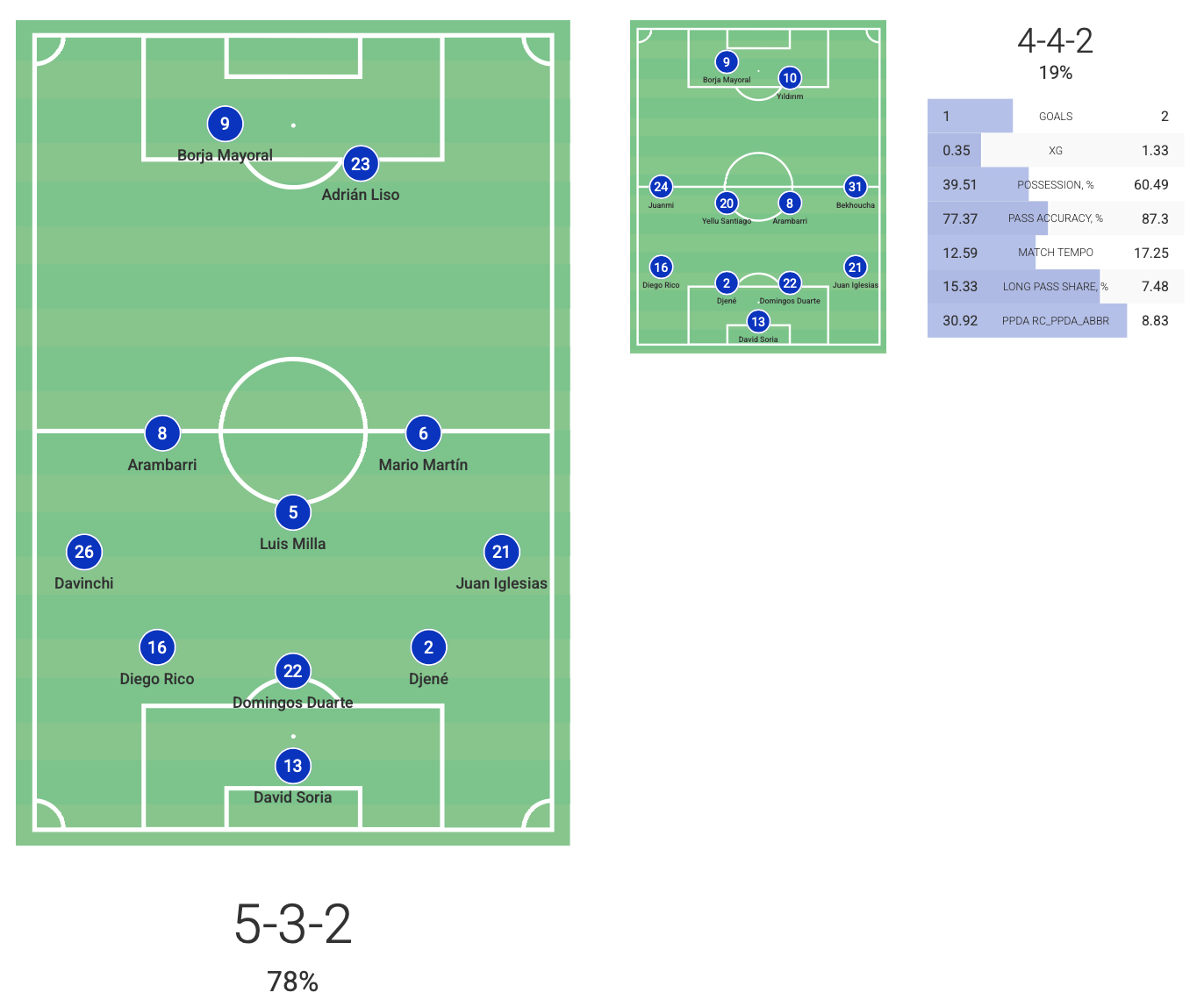
Getafe have been operating primarily in a 5-3-2 system (78% of matches), occasionally shifting to 4-4-2 depending on the opposition. This defensive-minded approach has been allowing them to pack the central areas while maintaining width through wing-backs Diego Rico and Juan Iglesias. The system's flexibility is evident in their PPDA variations—from 7.22 in their 5-3-2 setup to 8.83 when deploying 4-4-2.
The backbone has been David Soria in goal, who has started every minute across all five matches (521 minutes), while Domingos Duarte has been providing aerial dominance with a perfect aerial duel success rate (100%). Diego Rico has been their most active defender, contributing 22 defensive duels (16.4% of team total) while offering attacking threat down the left flank.
Their defensive third work has been particularly impressive—they have been showing discipline in maintaining compact shapes and winning crucial duels in dangerous areas. The 5-3-2 has been allowing for numerical superiority in central areas, exactly what they'll need against Barcelona's intricate passing combinations.
Attacking Dynamics
Luis Milla has been remaining the creative fulcrum with 11 key passes and 3 assists, operating as the primary playmaker from deeper positions. His partnership with Mauro Arambarri has been providing both defensive solidity and progressive passing ability.
The attacking threat has been coming primarily through Adrián Liso (3 goals) and Chrisantus Uche (1 goal, 2 assists), who have been offering pace and physicality in transition. Borja Mayoral has been providing the aerial presence at 182cm, particularly dangerous from set pieces.
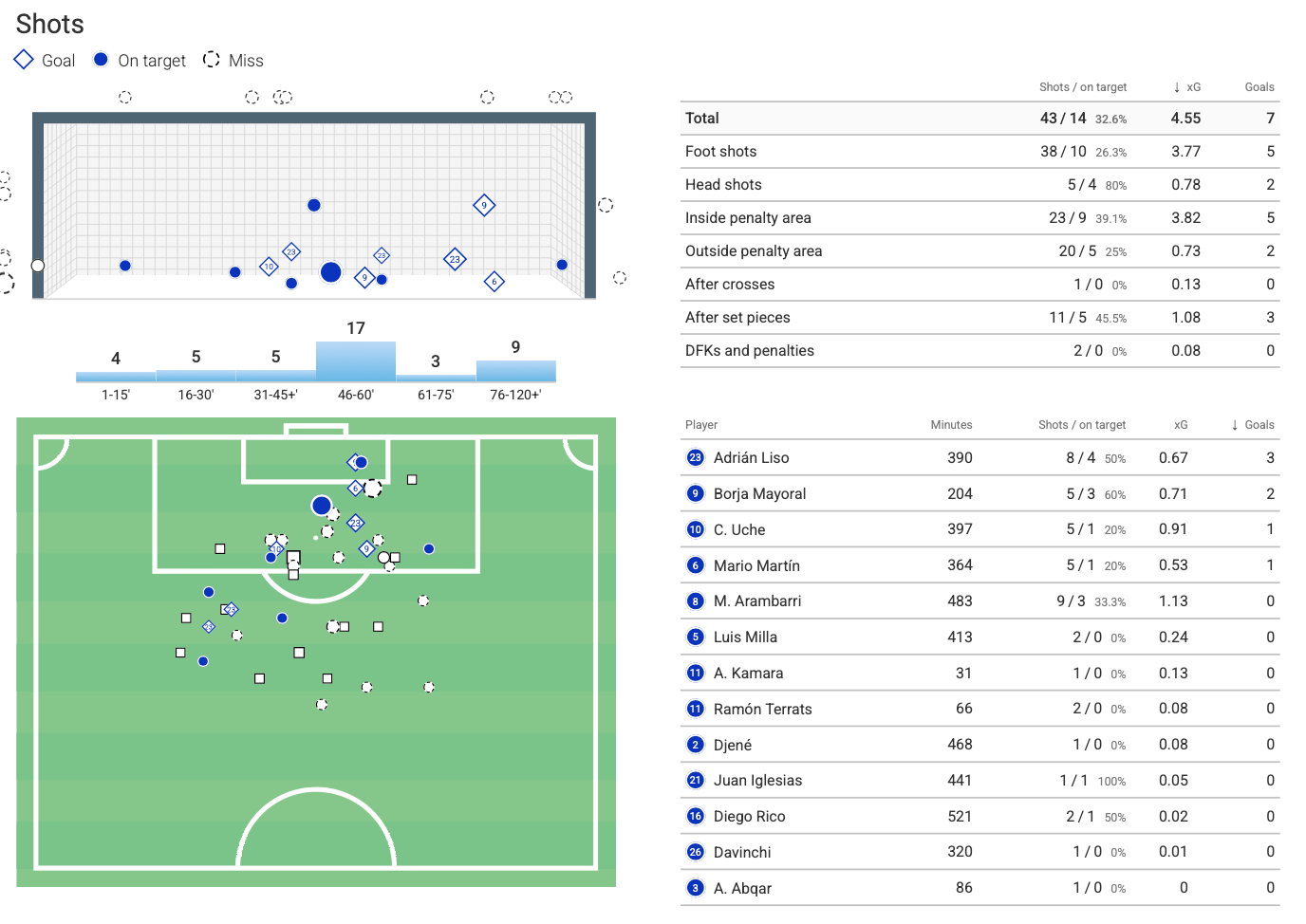
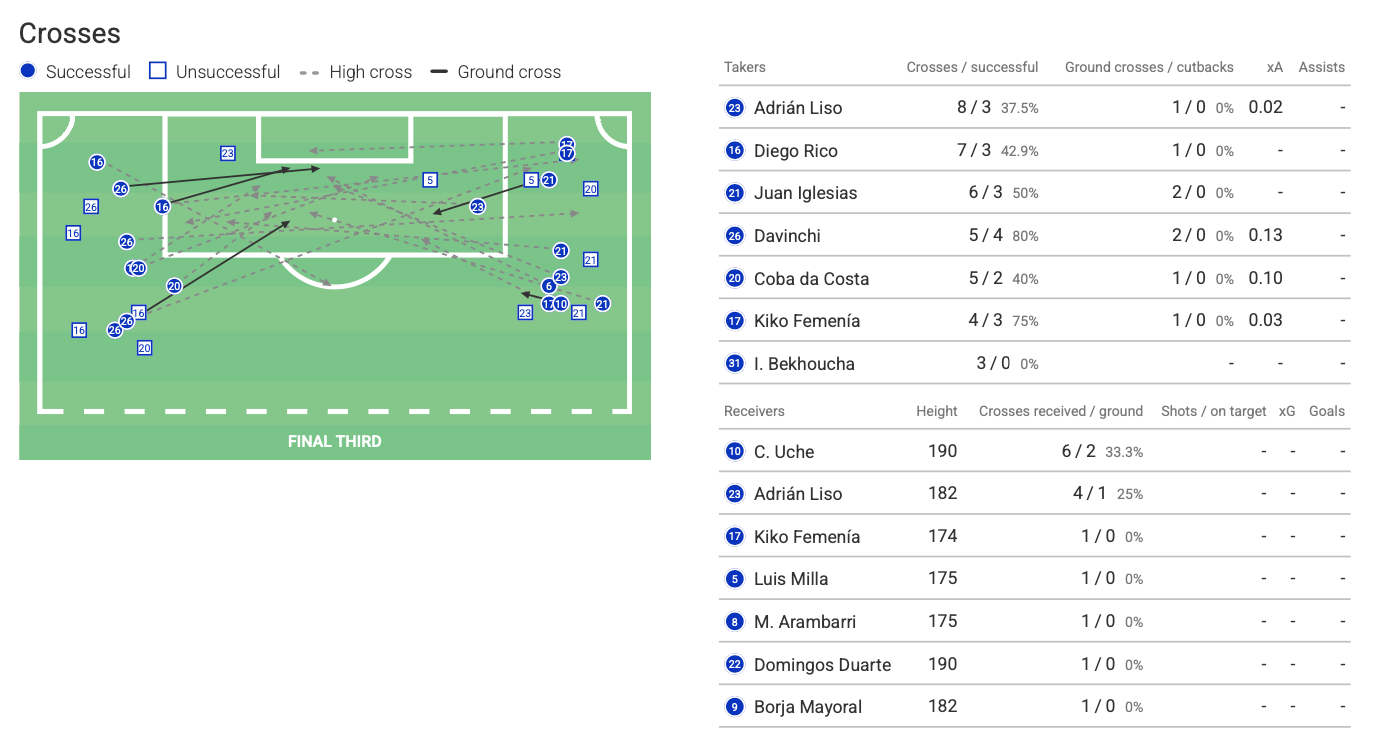
Getafe's set piece delivery, primarily through Milla's right foot, has been presenting a genuine threat. With 16 corners taken across their matches and strong aerial targets like Mayoral (182cm) and Duarte (190cm), they have been converting from dead ball situations—a potential route against Barcelona's sometimes vulnerable defensive transitions.
Barcelona's Blueprint to Break the Block
However, Getafe's 5-3-2 system, while defensively robust, has been creating specific vulnerabilities that Barcelona's technical quality can exploit.
Exploiting Wide Channels: Getafe's wing-backs tuck inside during defensive phases, leading to natural wide spaces emerging. Raphinha's pace and dribbling ability will be crucial in stretching this block initially before making diagonal runs inside to exploit the space between Getafe's centre-backs and wing-backs.
Central Overloads Through Pedri: With Getafe having been relying heavily on Luis Milla (11 key passes) as their primary creative outlet, Pedri's ability to drop between lines and receive in tight spaces could draw Milla out of position. This could create space for other Barcelona midfielders to advance and overload Getafe's compact midfield.
De Jong's Progressive Carrying: Getafe have been averaging only 40-60% possession depending on opponent, indicating they defend in compact blocks for extended periods. De Jong's ability to carry the ball forward and drive at the defense could force Getafe's midfield to step out of their disciplined shape, creating gaps for through balls.
Lewandowski's Intelligent Movement: While Domingos Duarte has been winning 100% of aerial duels , suggesting direct crosses may prove ineffective, Lewandowski's movement off the shoulder and hold up play could be key. Rather than engaging in aerial battles, he'll need to exploit the space between Getafe's midfield trio and defensive line—an area where their 5-3-2 has been occasionally vulnerable during transitions.
Tempo and Rhythm Variation: Getafe's defensive structure has been most effective when they can set their block and force opponents into predictable patterns. Barcelona's ability to vary tempo—quick passing combinations followed by sudden changes of pace—could catch Getafe between defensive phases, particularly exploiting moments when their wing-backs are caught between wide and narrow positions.
Tactical Approach vs Barcelona
Defensive Strategy: Expect Getafe to deploy their 5-3-2 in compact defensive blocks, looking to force Barcelona wide and limit central penetration. Rico and Iglesias will tuck inside when defending, creating a back seven to clog passing lanes.
Pressing Triggers: They have been employing selective high pressing when opposition center-backs receive the ball, particularly targeting any hesitation or backward passes.
Transition Game: The key to Getafe's attacking threat has been quick transitions through Liso's pace down the left and Uche's hold-up play centrally. They have been looking to exploit any space behind opposition full-backs, something they'll hope to capitalize on if Barcelona's full-backs push high.
Key Vulnerabilities Barcelona Can Target
Creative Dependency: Getafe have a over-reliance on Milla for creativity. If Barcelona can successfully press and isolate him—potentially through Pedri's intelligent positioning and movement—Getafe might lack alternative creative outlets from midfield.
Possession Limitations: With Getafe having been averaging significantly less possession than their opponents, Barcelona can force them to defend for extended periods. The wing-back system becomes increasingly vulnerable as the match progresses and players tire from constant defensive work.
Set Piece Defending: While dangerous from their own dead balls, Getafe's compact defensive approach means they could struggle with Barcelona's technical superiority in wide areas. Quick combinations around the penalty area from corners and free kicks could prove decisive.
Getafe have been making matches physical, attritional affairs—exactly Bordalás' blueprint. They have been defending deep, pressing selectively, and looking for set piece opportunities or quick transitions. Their recent form suggests confidence, but Barcelona's technical quality and ability to create overloads in multiple areas of the pitch should eventually overcome their defensive structure.
The key battle will be whether Getafe can maintain the defensive discipline they have been showing for 90 minutes while creating enough threat from transitions and set pieces. Barcelona's patient build-up play, combined with individual quality from players like Pedri, De Jong, and Raphinha, should provide the tools necessary to unlock a defense that, while well-organised, has shown vulnerabilities when forced out of their compact shape.
Expect a tactical chess match where Barcelona's technical superiority will try to gradually wear down Getafe's defensive resolve. The game likely will be decided by a moment of individual brilliance or a well-worked set piece routine.

Barcelona Salary Cap Drops €112M to €351M Following VIP Box Audit Dispute
To better understand the situation you should probably read the below article first
FC Barcelona's LaLiga salary cap has fallen 24% from €463M to €351M following auditor rejection of a €100M VIP box revenue stream. This creates a €410M spending gap versus Real Madrid's €761M cap.
Financial Impact
LaLiga's official salary cap data shows Barcelona's limit dropped €112M between February and September 2025. The reduction stems directly from auditor Crowe Spain's refusal to certify €100M in VIP box revenues that predecessor Grant Thornton had approved.
Key Metrics:
Current salary cap: €351.3M (down from €463.6M)
Real Madrid comparison: €761.2M vs €351.3M (2.17x difference)
Reduction percentage: 24% quarter-over-quarter
Transfer spending: €27.5M (García €25M, Bardghji €2.5M)
Barcelona's position remains second in LaLiga, €24M ahead of Atlético Madrid's €327M cap, but significantly behind Real Madrid's industry-leading limit.
VIP Box Revenue Dispute
The €100M transaction involves 475 VIP seats at the future Spotify Camp Nou:
New Era Visionary Group: €70M for 350 seats
Fortia Advisor Limited: €30M for 125 seats
Structure: 20-year usage rights plus €25,000 annual per-seat payments
Crowe's rationale centers on asset recognition: since Camp Nou renovations remain incomplete and VIP boxes don't physically exist, the €100M cannot qualify as 2024-25 revenue under accounting standards.
LaLiga director general Javier Gomez confirmed: "The €112 million coincides with the €100 million from VIP boxes. One auditor said yes, then another said no."
Debt and Revenue Context
Barcelona's financial position shows:
2023-24 revenue: €800.1M ($821M per CNBC conversion)
EBITDA: €61M ($66M)
Net debt: €1.35B as of 2021 (latest verified figure)
Stadium financing: €1.45B for Espai Barça project
Camp Nou exile costs the club €70-80M annually in lost revenues. Current venue Johan Cruyff Stadium holds 6,000 versus Camp Nou's 99,354 capacity.
The club's 2023-24 results showed:
Ordinary profit: €12M
Sponsorship revenue: €210M+ (record)
BLM merchandising: €110M (72% increase since 2018)
Player sales: €80M+ profit
Competitive Analysis
Real Madrid's €761.2M cap increased €6.4M year-over-year, reflecting:
Completed Bernabéu renovation revenue streams
Controlled wage structure
Sustained commercial growth
Current wage bill estimates (Capology):
Barcelona: €221.4M (€4.26M weekly)
Real Madrid: €305.4M (€5.87M weekly)
This creates a utilization rate of 63% for Barcelona versus 40% for Real Madrid against their respective caps.
Registration Challenges
Barcelona's restricted transfer activity included forced sales of established players like Iñigo Martínez to comply with FFP requirements. New signings García and Bardghji required complex registration procedures under LaLiga's 1:1 spending rule.
The club currently operates above the 1:1 threshold, meaning any new spending requires equivalent revenue generation or player sales.
Historical Perspective
Barcelona's salary cap evolution shows extreme volatility:
2022 September: €656M
2024 February: €204M
2025 February: €463.6M
2025 September: €351.3M
This represents a 46% decline from the 2022 peak and creates structural competitive disadvantages versus financially stable rivals.
Forward Outlook
Recovery scenarios depend on:
VIP box validation: Crowe auditors require physical completion of VIP areas by June 30, 2026
Stadium return: Camp Nou reopening scheduled for August 2025 (ceremonial) with full completion by August 2026
Revenue growth: Club targets €1.1B annual revenue by 2027
Credit rating improvements: Morningstar DBRS upgraded Barcelona's outlook from "stable" to "positive" in June 2025, supporting future refinancing options.
Risk factors: Continued stadium delays, auditor disputes, and LaLiga regulatory changes could further constrain spending capacity.
Investment Implications
The €410M spending gap with Real Madrid represents a structural disadvantage requiring 3-5 years to close under current revenue trajectories. Barcelona's reliance on academy development and asset sales will continue until stadium revenue normalization occurs.
Bottom line: At €351M, Barcelona's salary cap constrains competitive squad investment while debt service obligations of €424M refinanced through 2050 limit financial flexibility. Recovery depends on successful stadium completion and auditor approval of deferred revenue streams.